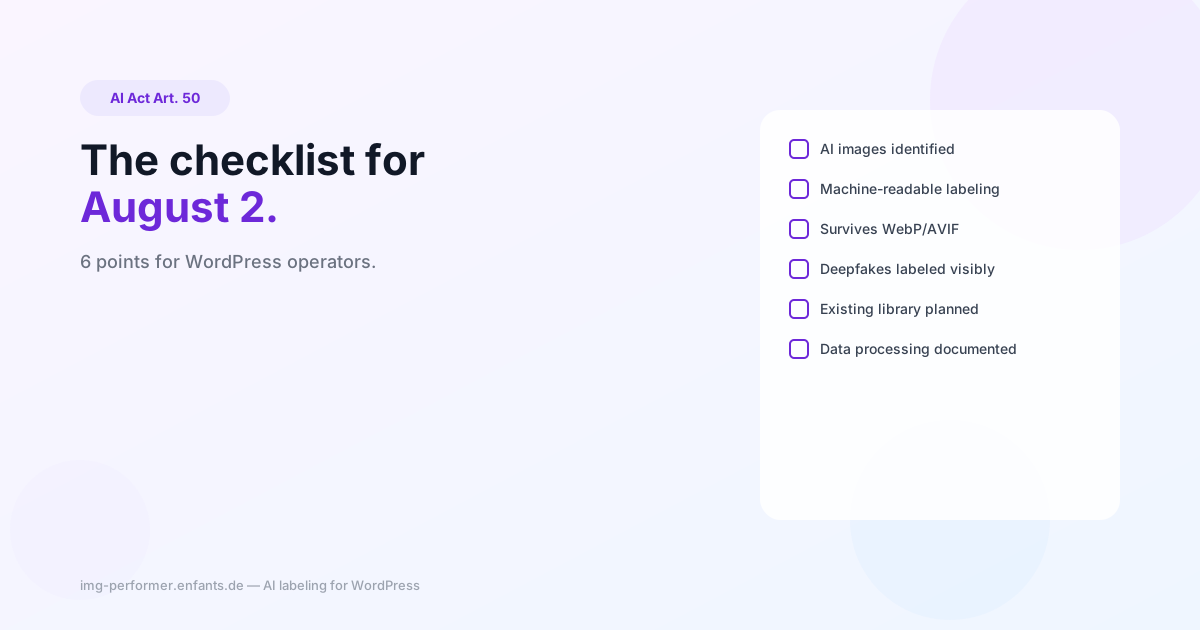
EU AI Act Art. 50: A checklist for WordPress operators
As of today, the labeling obligation for AI-generated images is in effect. A compact checklist of what WordPress operators should check right now.
Article 50 of the EU AI Act takes effect today, August 2, 2026. If you publish AI-generated or AI-modified images on a WordPress site, you now need to label them. This checklist summarizes what to check concretely — without replacing legal advice.
1. Does this even apply to me?
The obligation applies to deployers — anyone publishing AI-generated or AI-modified content, regardless of company size. That covers not just images from Midjourney, DALL·E, or Stable Diffusion, but also AI-edited photos (retouching, background replacement) and synthetic stock images.
Check: Which images on your site are AI-generated or AI-modified? A quick look at the media library rarely catches everything — many images were uploaded without any conscious labeling decision.
2. Is there a machine-readable label?
The core requirement is a machine-readable label — not just a note in the body text. Common approaches are metadata markers like IPTC DigitalSourceType or an equivalent XMP entry written directly into the image file.
Check: Are new uploads automatically classified and labeled, or is this done manually (if at all)?
3. Does the label survive your own image pipeline?
When an optimization plugin generates a WebP or AVIF version from the original, that’s a new file — with potentially empty metadata, if the plugin generating it has no concept of the label. More detail here: Why AI labeling and image optimization belong together.
Check: Is the label present in the file actually served to visitors — not just in the original sitting on the server?
4. Deepfakes need an additional visible label
For images that convincingly imitate a real person, event, or object (deepfakes), machine-readable labeling isn’t enough — an additional visible notice for visitors is required.
Check: Are there any images on your site that qualify as deepfakes? If so, is a visible label in place?
5. Existing media library, not just new uploads
The obligation applies immediately to new uploads. For already published images, the AI Omnibus grants a transition period until December 2, 2026 — but the transition shouldn’t start right before that second deadline.
Check: Is there a plan (or tool) to retroactively review and label existing media library images?
6. Is the data processing documented?
Does detection/labeling run locally on your own server, or is image data sent to an external service for it? The latter can trigger additional GDPR obligations (a Data Processing Agreement).
Check: Is it known where image data goes during labeling?
Quick summary
| Question | Status |
|---|---|
| All AI images identified? | ☐ |
| Machine-readable labeling active? | ☐ |
| Label survives WebP/AVIF conversion? | ☐ |
| Deepfakes additionally labeled visibly? | ☐ |
| Plan for existing media library in place? | ☐ |
| Data processing local/documented? | ☐ |
IMG Performer already covers points 1–3 and 6 in the free version (local detection, automatic labeling that reaches the generated WebP/AVIF files too); point 5 (retroactive bulk scan of existing images) and badge customization for visible deepfake notices are part of PRO.